






Answer
Yes. Supplementary assessment is available to students enrolled in an Honours coursework course. Supplementary assessment is not available in all programs. Refer to your course profile to find more information on supplementary assessments.
Â
Maintaining good academic progress is essential to succeeding in your studies at Griffith.
Griffith offer services and resources designed to get you up to speed on the academic progress procedure, and support to help you improve if you find yourself falling behind.
The University uses the term academic progress to describe how well you are performing in your studies at Griffith. Your academic progress is measured twice a year and is calculated by your program Grade Point Average (GPA) and successful completion of courses. The Academic Progress Procedure sets out how the University manages this process.
You are considered to have good academic progress if you:
If your GPA falls below a certain level and you fail to successfully complete assessments, the University will reach out to let you know you're at risk of not maintaining your good academic progress and offer support.
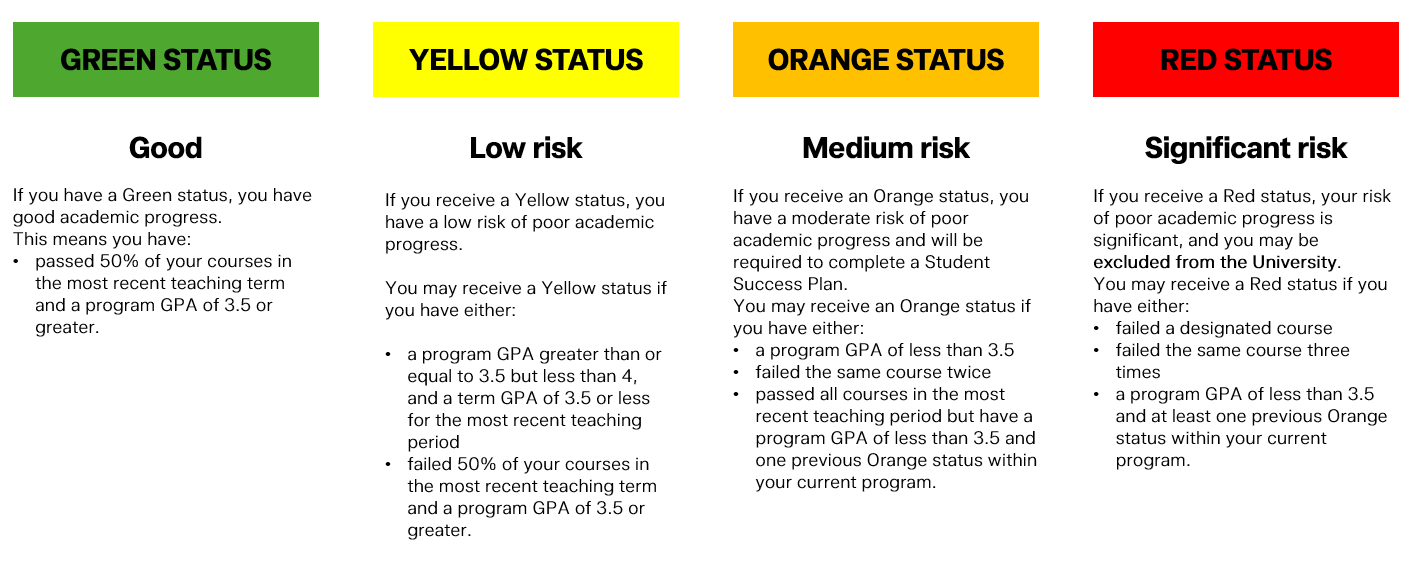
The University will let you know your level of risk, which is represented as a colour-coded status:
Â
Griffith has a wide range of support to help you retain good academic progress and improve your grades.
You will be required to complete a Student Success Plan if you are on Orange status. It is designed to help you reflect on factors impacting your studies and form your strategies to improve your academic progress. From your responses to questions in the 5-10 minute questionnaire you will receive tailored content which will provide you with support information for you to consider in your planning.
This plan is primarily for your own personal self-reflection and planning but may be accessed by relevant University staff for the purpose of supporting you in your academic progression and may influence an academic progress review if that was to occur in the future.
Join our Be On Academic Track (BOAT) program to receive personalised academic support.
Through BOAT, you can identify your goals, develop effective study strategies and build a personalised plan for success.
If you are an international student, make an appointment with your international student advisor to discuss your academic progress status as soon as possible.
Your advisor will explain possible implications to your student visa and help you make a plan to get your studies back on track.
The Library's Study and assignment skills webpage is packed with resources to help you succeed in your studies. The page can provide advice on:
making effective notes
researching and writing assignments
referencing
exam preparation.
Griffith's student mentoring programs provide a relaxed atmosphere to engage with others, break down complex ideas together and develop skills for academic success. Some programs you might find helpful include:
Study support, where you can drop in for tips on writing, referencing, researching and assessments
Peer-Assisted Study Sessions, where you can join group learning sessions for some courses students find particularly challenging.
It's important to reflect on whether your chosen degree still aligns with your goals and interests. Consider the following questions:
Are you are having difficulties with the materials because you're not enjoying what you're studying?
Have your career goals have changed since you started your studies?
Have you have developed a strong interest in another field of study?
You can also explore other study options using our degree finder or Open Universities Australia (OUA) degrees.
You may benefit from talking with your program director, course convenor, lecturers and tutors about your program, the courses and the academic content.
Reading over your course material before class is also great practice, and may spark questions to ask your lecturers and tutors in class.
Yes. Supplementary assessment is available to students enrolled in an Honours coursework course. Supplementary assessment is not available in all programs. Refer to your course profile to find more information on supplementary assessments.
Â
If you fail an honours course, your enrolment will be cancelled unless there are extenuating circumstances, and your candidature can be terminated.
As an honour's candidate, under normal circumstances if you fail a course you are not permitted to repeat the failed course or undertake an alternate course as a replacement for the failed course.
Normal circumstances may include:
If these are the circumstances under which you failed a coursework course, it is likely that you will no longer be able to complete the 80 credit points required to earn the honours degree. As a result, your enrolment as an honours student will be cancelled, and your candidature will be terminated. In special circumstances, however, the Honours Program Director may recommend to the Deputy Head of School to permit a retake of the failed course or undertake an alternative course as a replacement for the failed course. The Honours Program Director may only make this recommendation if specific conditions are met as stated below:
In this instance, you may be permitted to repeat a failed course, or undertake an alternative course as a replacement for the failed course, but the failed grade will still be included in your academic record, and the calculation of your Grade Point Average.
If your academic performance does not improve, you could eventually be excluded. A student who is excluded is not permitted to attend classes or undertake study in the program from which they were excluded or in any other Griffith program, including non-award programs.
A student may be eligible for exclusion if they have:
You can find more information in the Academic Progress Procedure.
If you are excluded, you have the option to take an early exit and request to graduate from an alternate award. Please note that eligibility is subject to you meeting the degree requirements of the alternative award, along with any requirements as outlined under the Graduations Procedure.
Â
Helpful links
Is there any further avenue for having an exclusion decision reviewed?
Can I recommence study once I have been excluded?
Can I request a review or appeal against exclusion for academic performance?
You can recommence study after two standard trimesters or nine calendar months, whichever is longer. To return to your program following exclusion, you must apply for readmission. Please note that your program director may also impose special conditions for readmission to your program.
Please note that you will not be readmitted to your program if you'll exceed the maximum time for completing your program. The maximum amount of time you have to complete your degree depends on the qualification and the year you were admitted. You can find more information in section 3.11 of the Enrolment Procedure.
You can request to graduate from an alternative award if you wish to take an early exit after being excluded.
Please note that eligibility is subject to you meeting the degree requirements of the alternative award, along with any requirements as outlined under the Graduations Procedure.
Speak to our friendly team who are happy to help